Uljan Sinani · Mechatronics & AI Systems · Leeds, UK
Building systems that have to work when it matters.
Senior mechatronics engineer with 6+ years taking electro-mechanical and robotic hardware from concept to the field — now bringing the same discipline of verification, control and fault-tolerance to AI and agent infrastructure.
Electro-mechanical and robotic modules — mechanical & thermal design, embedded electronics, sensor integration, closed-loop control — taken through DFMA, FMEA and on-site commissioning until they hold up in harsh, real-world conditions.
02 / Digital systems
Verification for AI & agents
Open standards and audit tooling for autonomous systems — permissioning, world-model fidelity, and the kind of kill-gated, evidence-first discipline that engineering reliability demands, applied to AI infrastructure.
The thread
Every project here is one question asked at a different layer: can you verify what a machine actually did?
In hardware, that meant mechanism design and actuation on a coating module pilot-run on decommissioned power lines — where "probably working" isn't a category. In research, it's the world-model latent audit: a controlled measurement of whether a learned representation retains the physical consequence a verifier would need — it doesn't, and the failure is measurable. In agent infrastructure, it's the Permissioning Protocol: a machine-readable manifest for what an AI workload may do on systems it doesn't own, with every decision auditable.
Capability is compounding faster than our ability to check it. The bottleneck — in robotics, in learned models, in agent fleets — is verification. That's the problem I work on.
/ 03
Selected work
001
DCAM - Dynamic Coating Application Module
DCAM module (centre) on LineDrone — Hydro-Québec field trialPhoto: AssetCool Ltd.
Led the development of Dyamic Coating Application Module (DCAM) - an electro-mechanical module that automates the deployment of a coating application module onto power-grid conductors, replacing the manual connect/disconnect work previously done by linemen at height. V1 concept deployed for the Base Robotic Platforms (BRP) at the test facility; V2 optimised for the UAV deployment and pilot-run on a decommissioned Hydro-Québec line via LineDrone - no operators at height.
Designed the mechanism in Fusion 360: Features developed consisted of: an over-centre Mechanicsm aimed at locking the module's arms closed without actuator assistance, retaining full clamping force as the module is pulled along the conductor. Actuation by Actuonix L12 linear actuators with integrated drivers, driven open-loop by external PWM from the platform or UAV - no onboard electronics. Took the module from concept to manufacture.
360° uniform coating across a 300 m conductor span — field trial with Hydro-Québec.
360° coating · 300 m span · Hydro-Québec field trial
Senior Mechatronics Engineer (Project Lead)
Physical Electro-Mechanical ModuleMechanism design - Fusion 360 · Actuation - Linear Actuators (with Over-The-Centre Feature) · Desig For Manufacture (DFM) - Machined body (CNC) and 3D printed. · MATLAB/Simulink (for Integration and Deployment simulation)● Field-trialled · June 2025
We all know the importance of using correctly the AI tools when developing along side with. We can't imagine writting code or assessing and extracting insights and patterns from a vast amount of data information and sources without the us of agentic tools. So, Permissioning 'Protocol'
is an open standard for AI agent permissions - "robots.txt for agent actions." A neutral, declarative way for systems to state what autonomous agents may and may not do, with a one-command quickstart reproducer.
The project already satisfies much of the constitution:
- It presents a concrete protocol object at a well-known path.
- It has a draft specification, reference enforcement code, quickstart, middleware demonstration, examples, and explicit limitations.
- It demonstrates observable effects at an API boundary: `allow`, `deny`, and `require_approval`.
- It openly states that v0.1 is not a production security boundary.
- It distinguishes declared conditions from conditions actually enforced.
- It invites criticism rather than implying standard adoption.
The public site currently does especially well on **problem clarity**, **proof over promise**, **quick inspection**, and **honest status**. The repository also specifies design principles, a manifest, rule effects, action designation, enforcement layers, open questions, and explicit non-goals.
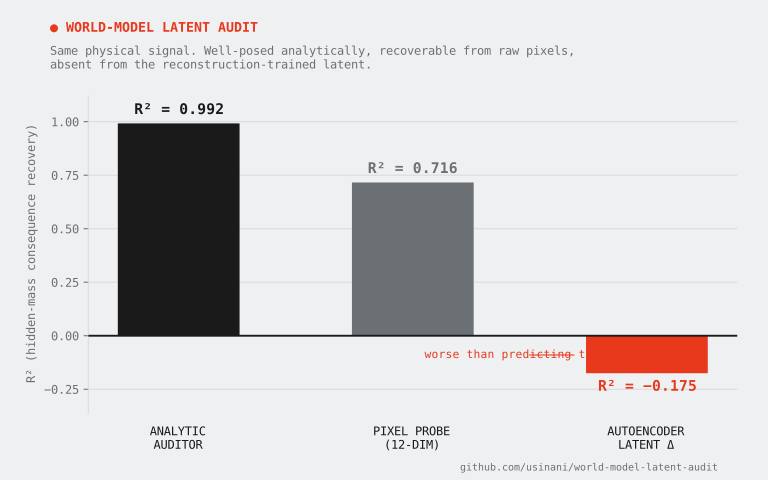
A controlled study of whether learned representations actually capture what causes outcomes. Built a contract-safe harness with stored splits and per-joint consequence targets in a physics simulation, then measured how well different latents recover causally-decisive variables.
Reconstruction latents underperform matched PCA and random projections on recovering causal variables — the gap tracks the objective.
R² 0.992 → 0.716 → −0.175
auditor → pixels → latent
Research · ReliabilityPython · Physics sim● Findings established
PhD research on the biomechanics of human body motion of tennis players.
The research started with collecting motion capture data of tennis players and using the data to inform a neural net to identify the key patterns, variables that discern a novice human player relative to an advanced tennis player. The insights from the neural net helped highlight the key facets that contribute on building a biomechanical model that closely embodies that of the human player. The latter, my research has shown, can be used in the future to embody real world physics based motion for VR avatars.
Current focus has been, modelling the human body upper-limb motion, based on a foundational two-link arm model to observe its motion characteristics and evaluate it relative to human upper body biomechanics. So, at the current phase, the simulated single-arm motion is used to generate synthetic movement data, benchmarked against motion-capture recordings I captured with an Axis Neuron suit.
Centrifugal-lift equilibrium holds in 3D — θ_eq = −6.26°, within ~0.3° of the reduced model.
System architectureRobotics & real-time controlEmbedded electronics & firmwareMechanical & thermal designSolidWorks · OnshapeMATLAB / SimulinkMuJoCo · OpenSimDFMA · tolerance analysisFMEA & reliabilityPython · C++ · ROSSensor integration · DAQPrototype-to-production · V&VApplied AI for physical systems
/ 06 — What's next
Building the verification layer for physical and autonomous systems.
I'm extending the engineering discipline that keeps hardware alive in the field — control, fault-tolerance, evidence-first verification — into the tools that will keep AI agents trustworthy. Open to senior roles, collaboration on agent-reliability infrastructure, or a conversation about hard systems problems.